
America's Roman Revolution

The Founders’ Rome
I spent America’s 250th birthday, and incidentally my own 28th, in New York. It was 39°C (102°F) and humid. A friend had, mercifully, invited a few of us up to his place in Connecticut; a low-slung mid-century house built over a stream with shaded gardens and a polystyrene archery-target shaped like a turkey.
We drove back to the city in the evening just as the heatwave was breaking into a thunderstorm that sent branches flying onto the freeway. It was the sort of weather that would have set the ancients on the lookout for omens. A flotilla of tall ships sent over from Europe and South America were being battered in the Hudson. We wondered if the fireworks in Central Park would be cancelled; “of course not,” our driver shrugged, “welcome to America.”
I know it’s treasonous to take any joy in Independence Day as a Brit; but as a classicist, it’s hard not to take a certain pride in the influence ancient Rome had on the founding generation and the country they created.
Republicanism was not a mainstream idea in 1776. Monarchy had been the norm for a millennium and a half; all the great nations of their world were ruled by kings and in parts of Europe you could hardly move for minor regnant princes. Whilst some rulers (including, ironically, the English king) were more constitutionally constrained than others, all oversaw establishments that conveniently maintained that monarchy was the only natural way of organising society.
If you wanted Republican dominance, you had to look further back – to the ancient world and, most of all, to the Republic of Rome.
Roman heroes
The Roman Republic, which lasted from the expulsion of the kings in c. 509 BC until the civil wars of the mid-1st century BC, was the most glorious non-monarchy on record. Armies led by elected consuls on behalf of the SPQR[1] built an empire that extended across the known world. By the mid-first century BC, Rome controlled around a quarter of the world’s population and a still greater proportion of her economic production.
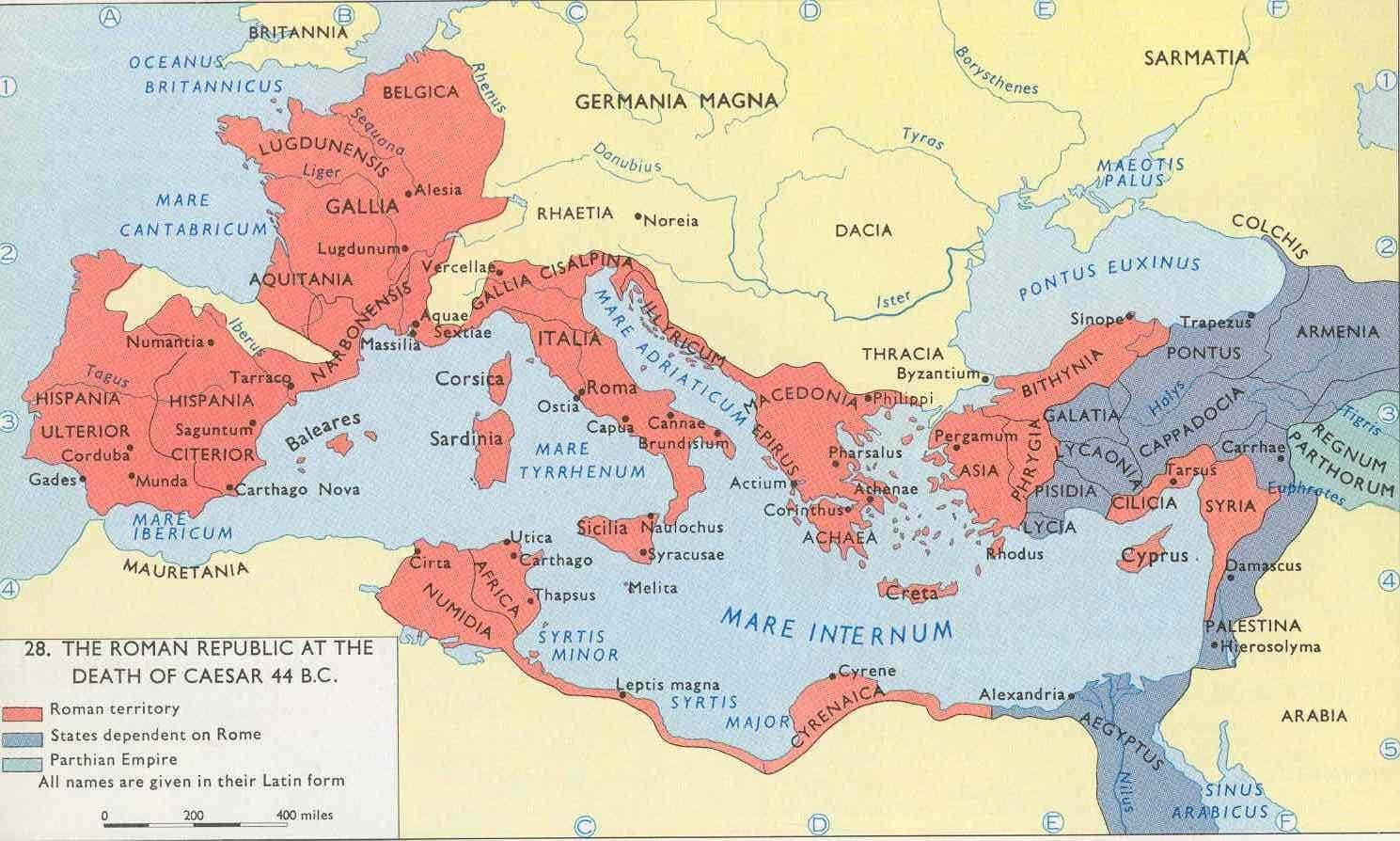
Here was proof that a republic could emerge as the dominant world power; such greatness was hardly likely in America’s case, of course, but it was pleasant to imagine.
The Romans of this period were pathological in their republicanism. The Republic believed itself to have been born from a dramatic repudiation of monarchy. According to the legendary history of its foundation, the citizen body had risen up against the tyranny of the last royal dynasty, the Tarquins, forcing them out of the city, transferring sovereignty to the Senate and People (SPQR), and swearing to never again tolerate the rule of a king at Rome.
This opposition to kingship became vital to Romans’ view of themselves. They began to believe that it reflected something particular and superior about their nature: a blood-born independence, a peculiar love of liberty (or more accurately, an inability to stand its alternative), that meant the Roman soul could not rest unless it was master of itself.[2] For a Roman living before the Caesarian fall, republicanism was the only route to liberty, and liberty was a necessity of life.
Now that was something a Virginian farmer could relate to.
The ideal Roman – a liberty-loving and patriotic land-owning farmer, self-sufficient but civic minded, successful but hardy and simple in their taste – certainly looked a lot like the ideal American. The revolutionaries began to view themselves as principled republican citizens rather than (the somewhat less romantic) troublesome provincial farmers.
One writer assured his readers that the Bostonians, holding out against the punitive laws passed by the British to cripple Boston Port in 1774, ‘have that fortitude which did honor to the ancient Romans.’ In a letter written to John Adams during the same period, William Tudor described his conversation with a Boston ship carpenter who told him he would rather hide out in the forests and eat acorns than submit to the British. ‘What a Roman!’ Tudor reflected, ‘By Heavens I glory in being this Man’s fellow Citizen.’ During the Virginia Convention of 1776, which resolved in favour of independence, men felt that they were ‘treading upon the republican ground of Greece and Rome’.
The leaders of the revolution took Romans for their guiding heroes. Washington looked first to the unyielding republican Cato the Younger, who chose death over submission to Julius Caesar. And later – when he resigned from office in 1797, setting the precedent of a two-term presidency – to Cincinnatus, who took on the dictatorship to save his country, before peacefully retiring to his farm as soon as the job was done. John Adams favoured Cicero, a more complex statesman-philosopher and the Republic’s most revered orator.
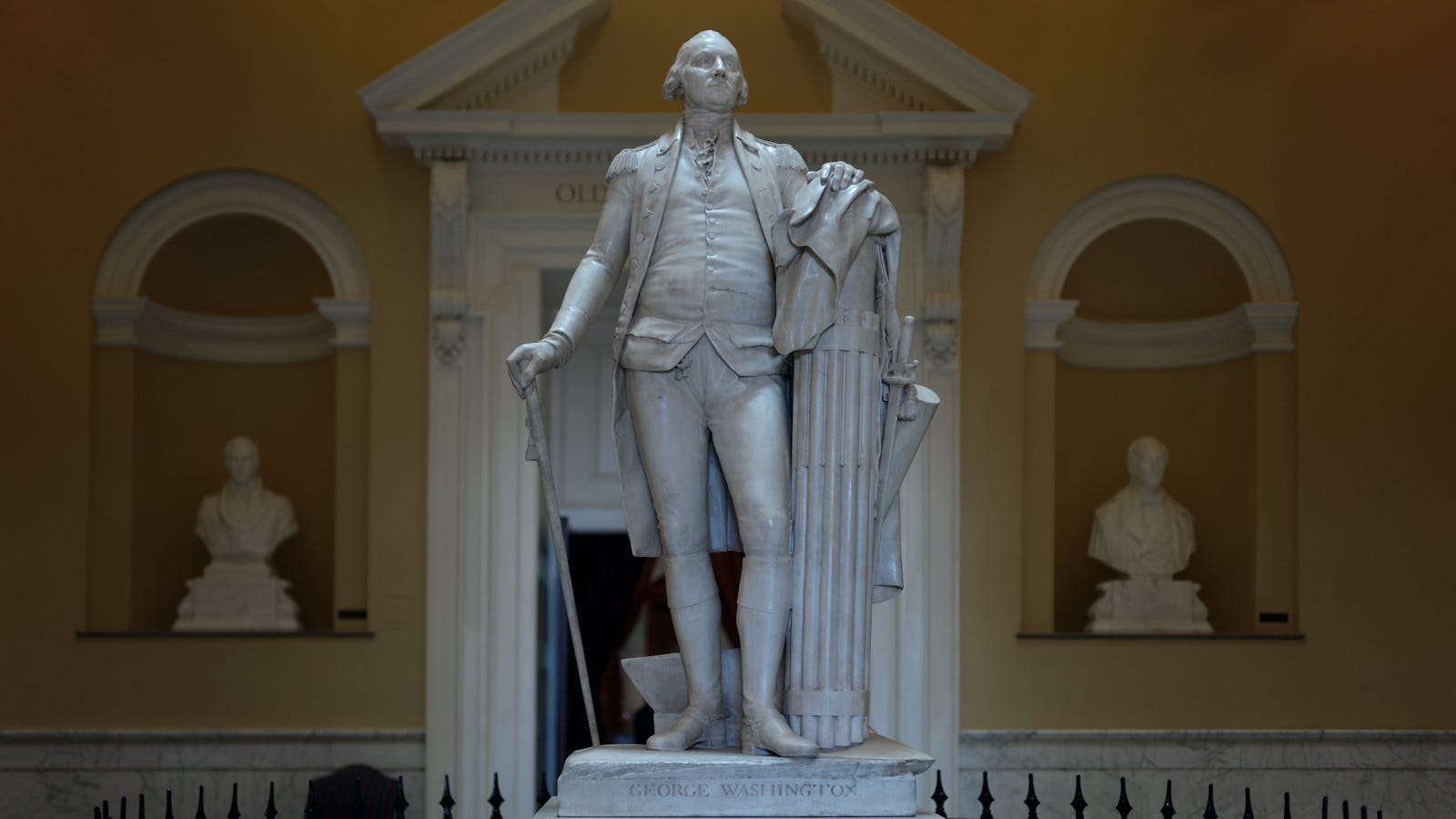
Nor were they reluctant to present themselves as these men’s direct successors. The pamphleteers who urged their compatriots to free themselves from Britain and, later, to ratify or reject the proposed constitution, wrote under ancient pseudonyms: Cato, Brutus, Publius, Mucius Scaevola, Cornelia, Agrippa, Helvidius Priscus.[3] Dr. Joseph Warren, who would soon die a hero at the Battle of Bunker Hill, delivered the 1775 oration commemorating the Boston Massacre in a toga.
A Roman revolution
These men saw their conflict with George III as a doublet of the late republican elite’s noble, if ultimately unsuccessful, struggle against the rising tide of autocracy that would wash up first Caesar then, after a short respite, Augustus and his Caligulan and Neronic successors. And they roused their countrymen to war by encouraging them to see it in the same light.
In one 1774 pamphlet, Josiah Quincy (the leading voice among Boston’s Sons of Liberty) wondered ‘is not Britain to America, what Caesar was to Rome?’ If the answer was yes, any well-educated man who believed himself temperamentally ill-suited to servitude (and which did not) knew that resistance was the only acceptable course of action.
By the end of the pamphlet, Quincy openly calls the Americans to emulate Brutus and Cassius, the men who led the assassination of Caesar and died fighting the civil war which followed.
BRUTUS-LIKE, therefore, dedicate yourselves at this day to the service of your Country; and henceforth live A LIFE OF LIBERTY AND GLORY. “On the ides of March” (said the great and good man to his friend Cassius just before the battle of Philippi) “On the ides of march I DEVOTED MY LIFE to my Country, and since that time, I have lived A LIFE OF LIBERTY AND GLORY”.… SPIRITS and GENII, like these, rose in Rome… such also will one day make glorious this more Western world. AMERICA hath in store her BRUTI and CASSII
The fiery Virginian legislator and future founding father, Patrick Henry, had concluded the introductory speech to his Resolves against the British Stamp Act of 1765 in a similar vein:
Tarquin and Caesar each had his Brutus, Charles the First his Cromwell — And George the Third may profit by their example![4]
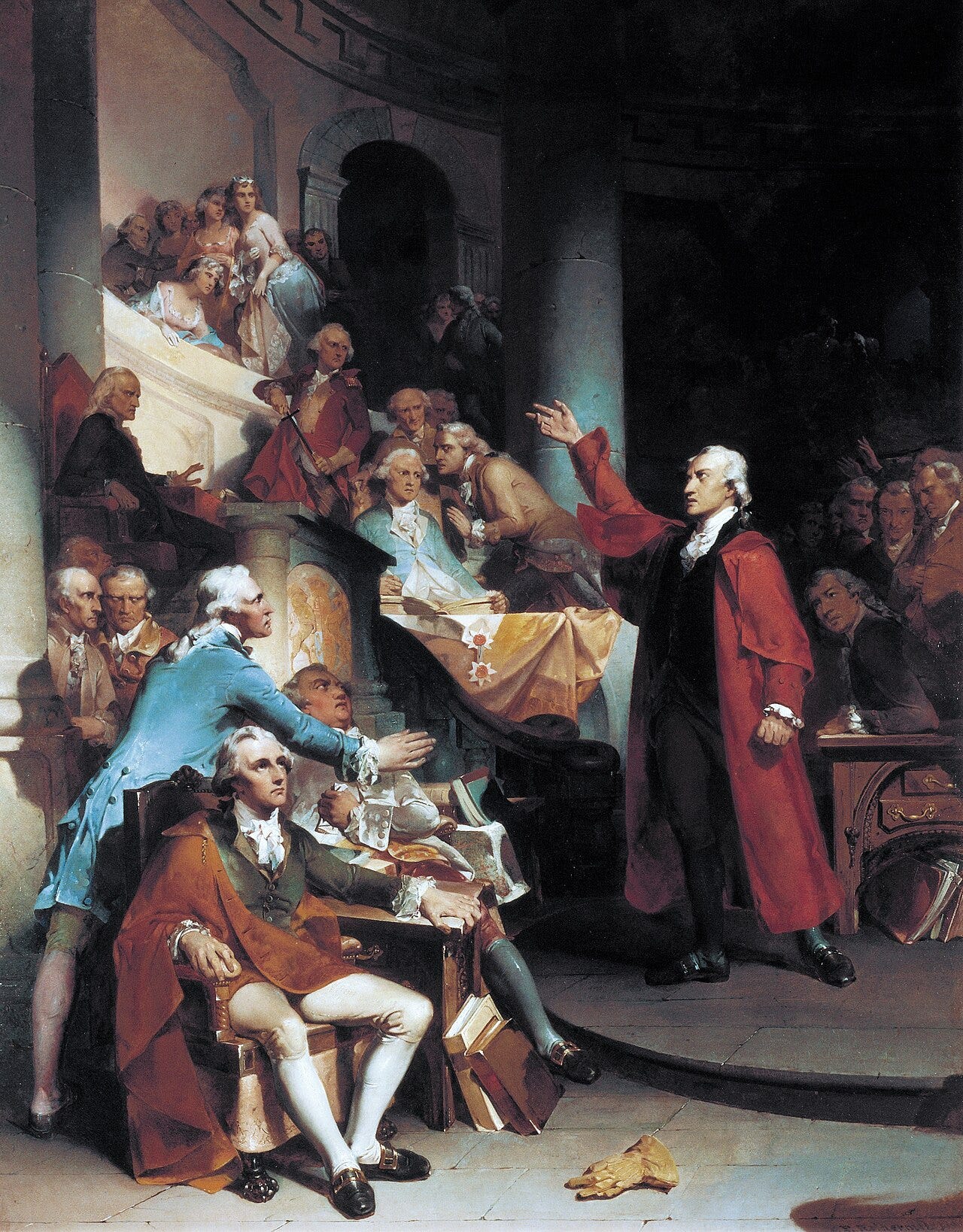
A decade later the situation had escalated. Henry rose in St. John’s Church in Richmond and gave the speech that convinced the Second Virginian Convention to arm an independent militia for war against the British Crown. These, according to later reports, were the final lines:
There is no retreat but in submission and slavery! Our chains are forged! Their clanking may be heard on the plains of Boston! The war is inevitable--and let it come! I repeat it, sir, let it come. It is in vain, sir, to extenuate the matter. Gentlemen may cry, Peace, Peace-- but there is no peace. The war is actually begun! The next gale that sweeps from the north will bring to our ears the clash of resounding arms! Our brethren are already in the field! Why stand we here idle?
What is it that gentlemen wish? What would they have? Is life so dear, or peace so sweet, as to be purchased at the price of chains and slavery? Forbid it, Almighty God! I know not what course others may take; but as for me, give me liberty or give me death!
That last phrase – give me liberty or give me death! – is still quoted today as a mantra-like assertion of America’s defining character. It derives, however, from a Roman hero by way of a British politician. The line, scholars agree, draws on the following verses of Joseph Addison’s Cato, a tragic retelling of ancient accounts of the death of Cato the Younger and the most popular play in America at the time:
Cato:
The hand of fate is over us, and Heav’n
Exacts severity from all our thoughts.
It is not now a time to talk of aught
But chains or conquest, liberty or death.
Contemporaries picked up on the allusion. St. George Tucker asked readers of his account to “imagine…this speech delivered with all the calm dignity of Cato of Utica”; John Roane recalled how Henry had “stood like a Roman Senator defying Caesar, while the unconquerable spirit of Cato of Utica flashed from every feature; and he closed the grand appeal with the solemn words ‘or give me death!’”
The dramatic glamour of all this should not be underestimated. Every successful revolution has combined principle with a certain seductive aesthetic. The Americans were never going to go in for the bearded dishevelment later developed by the Bolsheviks, and Rome provided them with an alternative: eagles, columns, grand success, grave togaed senators, manly self-sacrifice.
Building a new (and improved) Rome
Rome was not just a call to revolutionary arms – behind the paywall we get into the foundational role it played in building the new American state once the war had been won.
[1] The Senatus Populusque Romaus, or The Senate and People of Rome.
[2] Later, these ideas would be used to justify Rome’s dominion over her provinces; one only had to look at the barbarian chiefs of the North and the gilded potentates of the East to know that these were men conveniently well-suited for political submission.
[3] All Roman heroes, most of them prominent fighters for the establishment or preservation of the republic.
[4] No precise contemporary transcript survives as a speech, and different accounts give different wordings. Many omit the mention of Tarquin, but I’ve chosen to include it because it aligns with the most contemporary references we possess e.g. the account given by William Robinson, the commissary of the Anglican Church in Virginia, in a letter written to the Bishop of London on 12 August 1765.
[5] Less hearteningly, they also provided the root for the term ‘fascism’.
[6] In Examination into the Leading Principles of the Federal Constitution.
Glad you had a good time celebrating the 4th. The NYC fireworks are indeed the best.
Everyone I know wasn't feeling especially proud this year, but we hope to get back to some of what we used to be.
The Bicentennial 50 years ago was an all-out extravaganza that went on forever and most people quite enjoyed it. I might still have something around from that, though I've moved so many times since my school days. The fireworks have improved a lot since then, though -- but that's down to the Chinese, of course!
My group's annual tradition was to have the day-long barbecue, sing along to the movie "1776" (surprisingly historically accurate for a musical, check it out), and then decamp to a deserted parking lot where one of the gang worked, from which you could see 3 different firework shows. We had to stop that during lockdown. However, for the past few years, we've been at a hotel which is 2 blocks from a big show, which means this year I sat on my room balcony with my feet up to watch.
Most of us really are good people. Sorry about the problem, but oligarchy...